



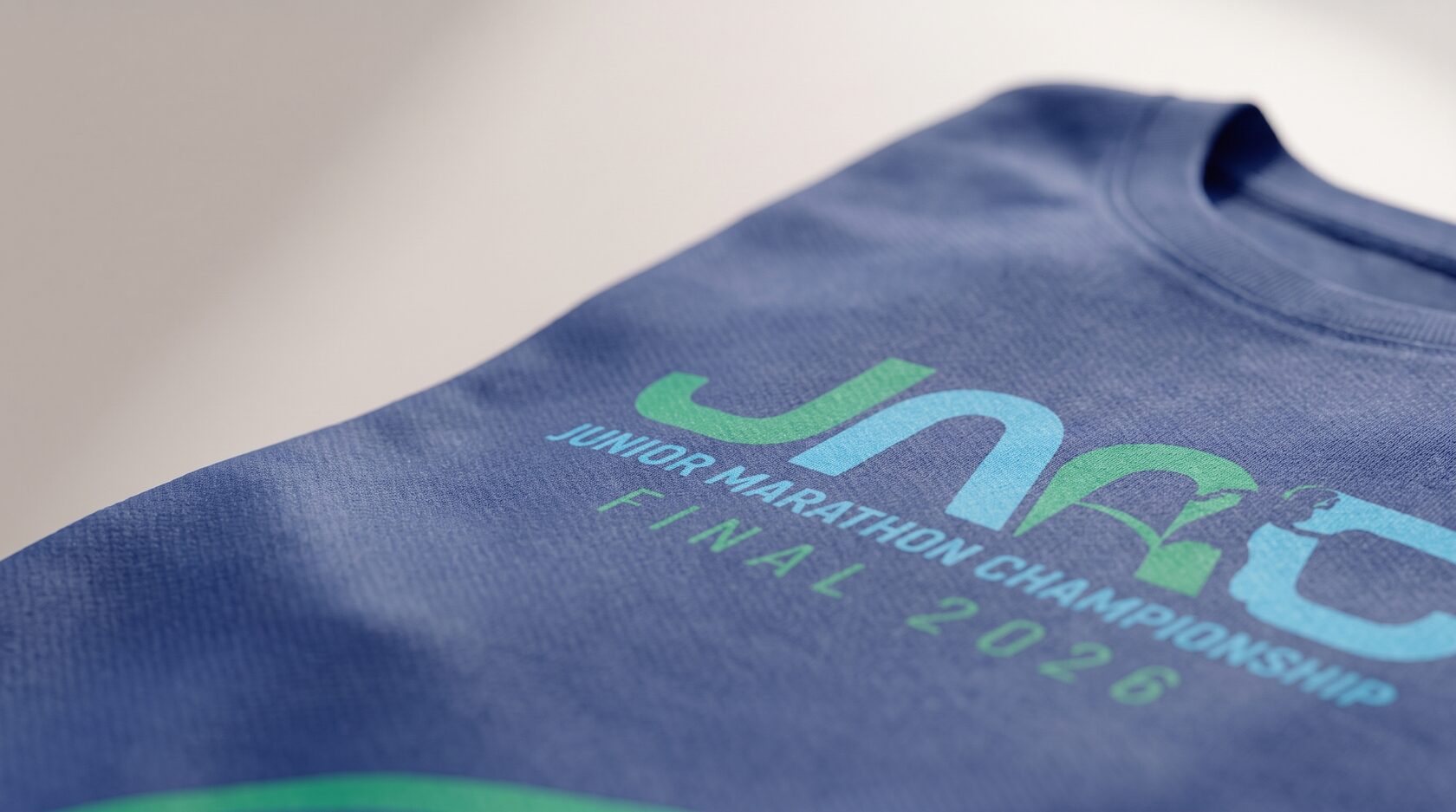
A practical guide for organizers of runs, cycling events and triathlons. What actually affects your budget, and what decides whether a participant wears your shirt a second time.
A participant receives the medal once, at the finish line, and hangs it on the wall. The shirt they wear for years: at training, on trips, around town at the weekend. Measured by how long it keeps your brand in view, it is the strongest carrier in the entire race pack — and also the item where money disappears fastest.
Four stories repeat themselves season after season. White title sponsor logos on red shirts turn pink within a week. Finisher shirts shrink two sizes after the first wash. After the event, 1,500 shirts in the smallest and largest sizes stay in the warehouse. The order went into production a month later than planned, and express shipping ate the entire saving on unit price.
None of these problems happens in production. All four are solved while the order is being prepared, months before cutting, and cost nothing at that stage. The only difference is whether the organizer knows which questions to ask before signing.
This guide follows on from our guide to choosing a finisher medal and is built the same way: first how it works, then what to do about it.
1. Finisher, staff and retail — three jobs often ordered as one
The most common overspend among new organizers looks harmless: order one type of shirt and hand it to everyone. Each item has its own role, and the requirements are genuinely different.
Hence the first rule of saving money: don't give finisher shirts to your volunteers. You pay for performance nobody needs, and at the same time you devalue the award your paying participant receives.
2. Why running shirts aren't made from cotton
Cotton absorbs moisture into itself. The shirt soaks through, gets heavy, dries slowly and starts to chafe on longer distances. For leisure merchandise and retail, cotton is ideal. For a finisher shirt it isn't.
Polyester works the other way round: it doesn't hold moisture, it moves it to the outer surface where it evaporates. There is one detail here that barely shows in a fabric description, but which participants notice after the tenth training run. Moisture transport comes in two forms. In good fabric, the channels are built into the shape of the fibre itself, and the shirt works for its whole life. In cheap fabric, a finish is applied to an ordinary smooth fibre, and it washes out after 20 to 30 cycles — after which the shirt simply stops working.
Recycled polyester (rPET) is the same material, made from PET bottles. In softness and moisture transport it matches virgin polyester, and it lowers the carbon footprint. One caveat, so you don't promise your sponsor more than you can prove: take the specific reduction figure from the documentation for your material, not from general articles online. The spread between sources is wide, and in 2026 an unverifiable number creates a problem rather than an advantage.
Fabric weight (gsm) affects both comfort and shipping cost.
One detail that saves you dozens of complaints in the finish area: white fabric below 130 gsm becomes see-through once it gets wet.
3. Printing: three technologies and one mistake everyone can see
Sublimation — the best choice for running. Under heat, the ink turns into gas and bonds inside the fibre. The print can't be felt with your fingers, doesn't block the pores of the fabric, doesn't rub off and doesn't crack. The limits are strict: synthetics only, light fabric only, and only before the garment is sewn. Sublimate onto a finished shirt and you get white unprinted creases at the seams and under the sleeves — visible on the very first batch.
Screen printing — the standard for medium and large runs. Opaque ink sits as a film on top of the fibres, gives strong colour and survives 50 washes and more. It has one drawback that matters for a running shirt: this kind of print doesn't let air through. A solid chest panel becomes a sealed shield that the participant overheats under. Two ways around it: water-based inks (softer and breathable, but they fade after 20 to 30 washes), or sponsor logos in a line version instead of solid blocks.
Transfer methods (DTF, flex) work well for small runs and name personalization. For a sponsor logo on a finisher shirt they don't: the print feels like film, and if pressing conditions are off it starts peeling after 20 to 30 washes.
4. Why the sponsor's colour won't match exactly, and how to agree on it in advance
Sponsor brand guidelines are written for paper. A Pantone fan describes how light reflects off a smooth coated sheet. Fabric absorbs light and has a structure of its own, which is why textiles use different colour systems. A full match between screen and shirt doesn't exist — and that's normal.
Accuracy depends on the method. In screen printing the ink is mixed physically and hits the target shade with 95–98% accuracy. Sublimation and digital printing build colour from four base inks, and part of the Pantone range simply can't be reproduced that way: neon shades and deep saturated blues will always differ.
Two approval steps remove almost every colour dispute:
- Fabric dyeing (lab dip) — the lab dyes a small piece of fabric to the target shade, usually 7 to 14 days. Assess it in normal daylight: dyes shift under different lighting.
- Print proof (strike-off) — a test print of the logo on the already approved fabric, another 5 to 7 days.
Good practice: agree the acceptable deviation from the sponsor's colour before the production run starts, and tie acceptance of the batch to the approved print proof. Then the conversation "I don't like this blue" happens over a sample rather than over delivered goods.
5. Sizes: how not to end up with a warehouse of extremes
Leftovers in the smallest and largest sizes are tied-up cash and dead weight in storage until next season.
Order in centimetres, not in letters. Letter sizes are standardized nowhere. An Asian L often equals a European M, and two suppliers can differ by 3 cm on the chest width of the same M. A workable specification is a measurement table: chest width, back length, sleeve length, and a tolerance of ±1–1.5 cm.
Collect sizes at registration. Make size selection a required field when a slot is purchased, with a measurement diagram in centimetres next to it. Organizers who do this report that dead stock almost disappears, and you get your own data for next season at the same time.
A starting point for your first order, if you don't have your own numbers yet: S 10–20%, M 25%, L 25–30%, XL 20–25%, XXL 10%. This is a market average, not statistics about your event: trail races and corporate runs shift the curve towards larger sizes, city road events towards smaller ones. Useful as a reference for a first run, not as the basis for an order covering 20,000 people.
Women's fit. Unisex means a men's pattern with wide shoulders and a straight silhouette. If women make up more than a quarter of your field, a separate fitted batch stops being optional: it directly determines whether she wears the shirt after the finish.
6. Timing: why to start earlier than feels necessary
Lead times in textiles vary a lot, and that is the good news: something is almost always possible. The only questions are what it costs and how many nerves it takes.
Stock garments from European warehouses with local decoration: 1 to 3 weeks. Cut-and-sew to your own patterns: 5 to 8 weeks. Full custom production with a long lead time: 12 to 16 weeks. If you have less time than would be comfortable, it can still be solved: production moves the order into a rush schedule and the goods travel by air. You pay for that twice, though — a rush surcharge and the freight difference. And there's a third price that appears on no invoice: you spend the last two weeks before the event refreshing the tracking page.
So we always say the same thing: the earlier you start, the more options you have and the cheaper the result. A comfortable schedule looks like this.
Three points worth settling with production in advance — they prevent the classic surprises at acceptance:
- Shrinkage. Up to ±5% after washing is normal for knitted fabric. If a factory promises zero shrinkage on a 150 gsm cotton shirt, that's either untrue or a heavy finish that disappears after the first few washes.
- One dye batch for the whole order. If the factory ran short of fabric and dyed the remainder separately, part of your run will be visibly a different shade.
- Carton inspection before shipping, with boxes opened and garments measured. Otherwise mixed-up sizes surface in the start area.
7. Sustainability: what works as an argument, and what becomes a violation in 2026
Sustainability in sport has stopped being a marketing topic and become a requirement from sponsor teams. A large partner can't put its logo on a product whose origin has no documentation behind it.
Certificates as a commercial argument. If you work with international or corporate sponsors, their sustainability departments will check the materials. In event textiles you most often encounter OEKO-TEX Standard 100 (safety in skin contact) and GRS (verification of recycled content). Ask at the enquiry stage which documents exist for the specific material: the set depends on the fabric and the factory, and it's better to know before you promise anything to a partner.
What changes on 27 September 2026. New EU rules on environmental claims start to apply. General wording such as "eco-friendly", "green" or "sustainable" becomes inadmissible without confirmation from independent certification. This covers not only the label on the shirt but also your registration site, banners and social posts.
The difference in practice: "Eco-friendly marathon" goes. "Shirt made from 60% recycled polyester, GRS certified" stays, because it can be verified. Before September 2026 it's worth going through all your materials and replacing one with the other.
Opt-out option. A field at registration where the participant deliberately declines the finisher shirt, and the organizer directs the saving into tree planting or their own environmental project. It works in two directions at once: it improves the event's profile and takes part of the run out of production.
How this looks in practice
For the Rodinná míle Praha — the family mile within the Prague Marathon — the organizers at RunCzech chose a fabric made from 100% recycled plastic. The task was to keep a demanding layout on new material: reflective elements and mesh panels for ventilation. We delivered the concept without simplifying the design, and at the same time removed individual plastic packaging almost entirely. Result: 3,300 runners received comfortable shirts, and packaging volume in the start area dropped to a minimum.
What follows from this
Merchandise for a mass-participation event is an engineered product. A mistake in the fabric brings complaints at the finish, a mistake in printing brings pink sponsor logos, a mistake in sizing brings a warehouse of shirts nobody wants. All three are prevented while the order is being prepared, before cutting, and cost nothing at that point.
A participant receives the medal once. With the shirt, they decide to put it on again.