



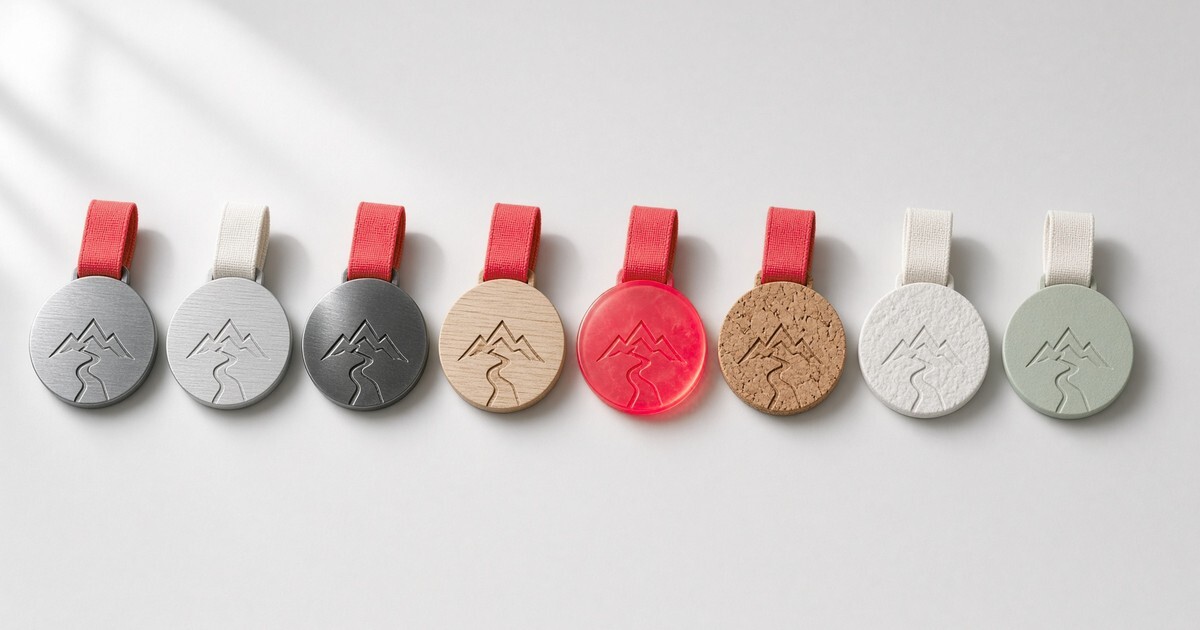
Eco medals made of recycled metal, wood, acrylic, cork, paper or bioplastic: if you want a finisher medal with a better environmental profile, you have more choice than you might think. Each material looks different, feels different and brings its own strengths.
Runners keep their medals, often for years. The environmental question is therefore decided in production. This guide shows the options and what to check for each one. The choice is yours.
- A medal's environmental profile is decided in production: raw material, recycled share, plating, ribbon and packaging.
- Each material has its own strengths. You decide which one fits your race.
- What counts is the proof: a percentage, a label with a number, a test report.
Where a medal's environmental profile is decided
Five stations from raw material to finished medal. At each one, you can ask your supplier.
- Raw materialNewly mined or recycled?
- ManufacturingCasting, laser cutting, printing
- SurfacePlating and paint
- RibbonPolyester, rPET or cotton
- PackagingSingle bags or shared carton
Eight materials compared
Typical properties at a glance. Sort by what matters to you.
- Recycled zincscrap metal instead of new zincWeightDetailLifespan
- Recycled aluminiumscrap metal, far less energy than newWeightDetailLifespan
- Steelpartly from steel scrapWeightDetailLifespan
- Woodrenewable, with FSC or PEFCWeightDetailLifespan
- Recycled acrylicrecycled plasticWeightDetailLifespan
- Corkbark, the tree stays standingWeightDetailLifespan
- Paper, cardboardwaste paper possibleWeightDetailLifespan
- Bioplastic (PLA)plant starch, for example cornWeightDetailLifespan
Scale 1 to 5. Typical values, which can differ by manufacturer and finish. Weight: 1 very light, 5 heavy.
You already know what you need?
Send a requestRecycled zinc: the classic with a better footprint
Most custom medals are made of a zinc alloy. It is cast into shape and delivers fine detail. If it is cast from scrap metal instead of new zinc, look and feel do not change. The difference lies in production: the zinc does not have to be newly won from ore.
Strengths
- The most design freedom: reliefs, cut-outs, several levels
- Weight that feels high-value, same look as new zinc
- Lasts for decades
What to check
- What percentage is recycled?
- Does the number cover only the medal body or also the ring and plating?
- Is there written proof?
lower emissions is what the British Great Run Company states for 100 percent recycled zinc, roughly 0.2 kilograms of CO2 per medal. London Marathon Events states that its medals are made from 100 percent recycled zinc.Organisers' own figures: Great Run Company, Environmental Report 2025; London Marathon Events
Recycled, but which part?
“Recycled” often applies to only one part of the medal. For each part, ask for the share and the proof.
- 1RibbonShare? Proof?
- 2RingShare? Proof?
- 3Medal bodyShare? Proof?
- 4Plating, paintShare? Proof?
Aluminium and steel: light or sturdy
For both metals, look at how they are made. Recycled aluminium needs far less energy than new aluminium. Steel can be made partly from steel scrap. How high the share is depends on the supplier.
Aluminium
- Light: saves on shipping, comfortable to wear
- Can be anodised: colour in the surface itself, no paint
Very fine reliefs usually work less well than with zinc.
Steel
- Sturdy and very long-lasting
- Ideal for clear, flat shapes cut by laser: logos, course profiles, outlines
Heavier than aluminium.
What to check
- Recycled share with proof
- Every additional coating step needs chemicals and energy
Wood: warm, light, full of character
Birch, beech, plywood or bamboo: wooden medals are light and can be laser-engraved very cleanly. With UV printing, colours are possible too.
Strengths
- Renewable raw material
- Low weight
- Natural look, clean laser engraving
What to check
- FSC or PEFC labels: controlled forestry, traceable supply chain. They say nothing about CO2.
- Wood without a label can come from doubtful sources.
- Plywood is glued. Lacquer, foils and plastic inlays bring additional substances into the product.
less than with zinc medals: that is how the Cologne Marathon organisers put the switch to wood. According to Runner's World, Cologne was the first major German marathon to drop metal medals for ecological reasons. The wooden medals cost somewhat more.Organisers' own figures, reported by Runner's World Germany
Recycled acrylic: colourful and light
Acrylic is a smooth plastic that can be printed in colour and can also be clear. It allows multi-layer, colourful designs, even in small runs.
Strengths
- Colour and transparency
- Multi-layer designs
- Small quantities possible
What to check
- Where does the recycled material come from? Often it is production offcuts from the factory, not used products. Both are recycled, but they are not the same.
- How high is the share, and does it apply to the whole product?
Cork and paper: very light raw materials
Both materials weigh next to nothing. In production, what matters most is where the raw material comes from.
Cork
- Bark of the cork oak: it is peeled off, the tree stays standing and grows new bark
- Soft, warm, very light
Cork breaks out fine details easily. Simple shapes work best.
Paper, cardboard
- Waste paper possible as raw material
- The lightest material in the comparison
The shortest-lived, and it does not like sweat on a warm run.
What to check
- Waste-paper share, and FSC or PEFC for virgin fibres
- For cork: binder and coating
Bioplastic (PLA): from plants, but not automatically degradable
Polylactic acid, or PLA, is a plastic made from plant starch, for example from corn or sugar cane. The raw material regrows. But the name “bioplastic” promises more than the material delivers.
Strengths
- Raw material from plants, for example corn or sugar cane
Careful with claims
- The German Federal Environment Agency stresses: bio-based plastics are not always biodegradable.
- Write “biodegradable” only if you can prove it.
- Here too, raw material origin, share and proof count.
The ribbon: at least as important as the medal
The ribbon is a visible part of the medal and easy to switch.
Recycled polyester (rPET)
- Made from recycled PET bottles
- Looks and feels like a normal ribbon, fully printable
- “Global Recycled Standard” label: checks recycled share and supply chain, for consumers from 50 percent
- Ask for the certificate number
Organic cotton
- Advantages lie in the growing
- Needs a lot of water
- Not an automatic winner over recycled polyester
Plating, paint, packaging
Many metal medals are nickel-plated to make them shine. Nickel can cause allergies, and a medal often hangs on wet skin for hours. Ask for a test report. “Nickel-free” without a test is only a promise.
per square centimetre per week: the most nickel a product may release in the EU during longer skin contact.EU chemicals law (REACH)
Surfaces you can ask for
- Nickel-free layers · with test report
- Vacuum coating (PVD) · no plating bath
- Untreated surface
- Hard enamel · glass-like
- UV printing
- Soft enamel · made of plastic
Packaging
The decision before the material
Every medal that stays in the box used raw material, energy and transport. Two steps help with any material:
You can also offer the medal as an option. A survey from North America shows what runners say:
name the medal as a reason for choosing a race
wish for an alternative to the usual finisher shirt
As a complement: Digital Awards. A digital medal and a digital hall of fame for everyone, the physical medal for those who care about it.
Three questions to ask yourself
- What do your runners expect?
Weight, look and the feel in the hand shape the impression.
- How much detail does your design need?
Fine and multi-layered makes different demands than clear and flat.
- What proof do you need?
Recycled share, labels and test reports are your argument towards runners and sponsors.
Checklist for your request to the manufacturer
Every material has its strengths
Metals are heavy and durable, wood is light and natural, acrylic is colourful, cork and paper are very light. The ribbon and the surface improve almost every medal. Which material you choose is your decision. What matters is that you know the material, the share and the proof.
At WITISI you get medals made of recycled zinc and of wood, ribbons made of recycled plastic, merchandise for your participants, on-site engraving and Digital Awards. We are happy to advise on other materials.
Which material fits your race?
Tell us about your event: number of runners, date, design idea. We advise you on material, quantity and fitting proof. Orders start at 70 pieces.
Frequently asked questions
Which materials are available for eco medals?
Options include recycled metal (zinc, aluminium, steel), wood, recycled acrylic, cork, paper and bioplastic, plus ribbons made of recycled plastic. Each material differs in raw material, look, weight, level of detail and lifespan.
Is a wooden medal better than a metal medal?
That depends on the raw material and on how it is made. Wood is renewable, light and engraves cleanly. Look for the labels FSC or PEFC (controlled forestry), little glue and no plastic inlays. Recycled metal scores with its recycled share. In both cases, the proof counts.
Is bioplastic (PLA) biodegradable?
Not automatically. Bio-based means the raw material comes from plants, for example corn or sugar cane. The German Federal Environment Agency stresses that bio-based plastics are not always biodegradable, and that biodegradable plastics break down only under certain conditions. So write “biodegradable” only with proof.
What does “recycled” mean for a medal?
On its own, the word says little. Ask three things: How many percent are recycled? Which part does the number cover (medal body, ring, plating, ribbon)? And what proves it?
What is the Global Recycled Standard?
A label for products made of recycled materials, for example ribbons made from recycled PET bottles. It checks the recycled share and the supply chain. For labelling towards consumers it requires at least 50 percent. Ask for the certificate number.
Should I ask for a nickel test report?
Yes, if the medal is nickel-plated. The EU limits nickel release during longer skin contact to 0.5 micrograms per square centimetre per week, and a medal often hangs on wet skin for hours. “Nickel-free” without a test is only a promise.
May I write “eco-friendly” or “climate neutral” on my race page?
Not without proof. Since 27 September 2026, strict EU rules against misleading environmental advertising apply. Name the material and the percentage instead, for example: medal body made of zinc alloy with 100 percent recycled content per manufacturer's declaration. This is not legal advice.
What is the minimum order quantity?
Orders start at 70 pieces. Tell us about your event and we advise you on material and quantity.
More questions? Write to us via the request form or at info@witisi.com.
Show sources
- Great Run Company, Environmental Report 2025 (organiser's own figures)
- London Marathon Events, environment page
- Runner's World Germany, “Nachhaltigere Lauf-Veranstaltungen” (Cologne Marathon)
- Umweltbundesamt, bio-based and biodegradable plastics
- Running USA, “What Event Swag Do Athletes Actually Want?” (Global Runner Survey 2022, North America)
- Directive (EU) 2024/825
- German Act against Unfair Competition (UWG), annex to section 3(3)