



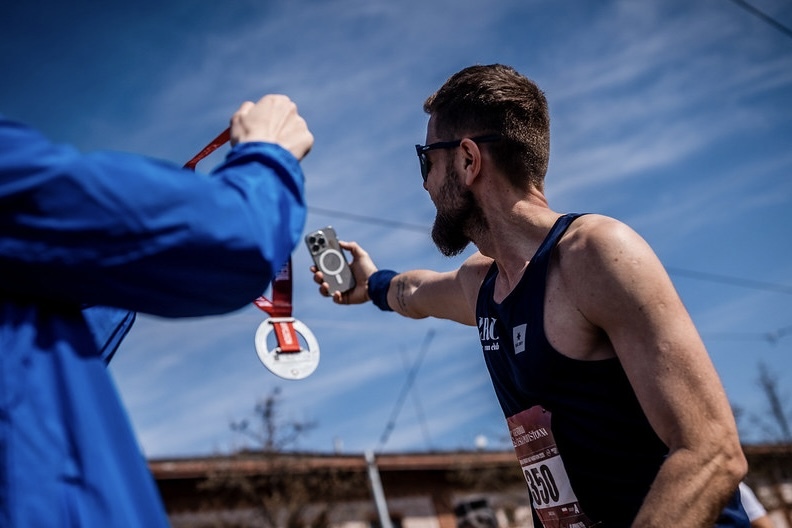
A finisher medal is not a souvenir or a participation trophy. It is the peak moment of your event, the object your participants use to judge the whole experience: the course, the logistics, the atmosphere. You hand it over at the exact second of their highest emotional high, and it stays on their wall for years, long after they have forgotten the banana at the finish. Treat the medal as a line in your budget, and you give up the cheapest and strongest lever you have for retention and referrals.
Why does the medal moment carry so much weight?
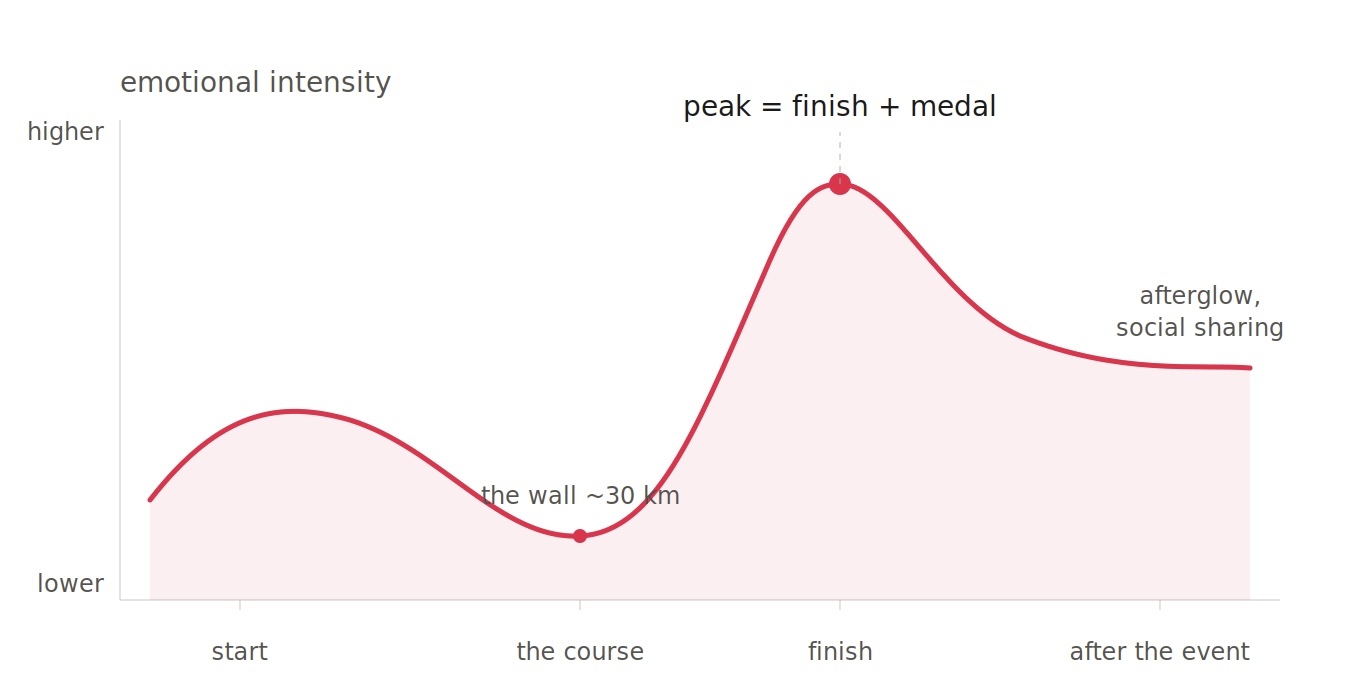
Crossing the finish line triggers a chain reaction. Endorphins dull the pain, a dopamine spike delivers the sense of triumph, and serotonin keeps your runner from crashing right after. You place the medal around their neck at that peak. The brain ties the physical object to the obstacle they just overcame, and the medal becomes an anchor: years later they pick it up and return to that state.
For you as an organizer, the peak-end rule (Kahneman) does the rest. People judge an experience not by its average but by its most intense moment and its ending. In a race, the peak and the ending land on the same event, the medal handover. That makes the quality of the medal, and the way you present it, count for more in the final score than most of the items you spend real money on.
Satisfaction vs. NPS: where does a medal move the needle?
Split two metrics before you set the medal budget.
Satisfaction measures your basic promises: a safe course, water on the stations, accurate timing, short queues. A medal at the finish is a hygiene factor here. Runners expect it, and handing one over earns no delight. It holds satisfaction at a normal level, no more.
NPS measures something else: whether they will recommend you to a friend. Only exceeding expectations moves NPS, through unusual weight, layered symbolism, a finish they have not seen before, personalization. The medal is the most photographed element of your event. The finish-line selfie has become a ritual, and every post works as free organic reach and as social proof that fills next year's registrations. Participant surveys rank the medal among the top reasons people choose a destination race, behind only the event's reputation and running with friends.
One example, not an industry benchmark: in the MUT by UTMB 2025 post-race survey, where runners called the medals beautiful and meaningful, 83% planned to return the following year at an NPS of 84.
How a medal works before, during, and after the race
The medal shapes the experience across every stage, not only at the finish.
Before the event. The medal design drives the registration decision. When several races fall on the same weekend, runners often pick the one whose award was shown early and looks more convincing. A quality render or a photo of a sample in social feeds starts the anticipation: the runner pictures the finish before training even begins. Your medal reveal works as a lead magnet for the registration campaign.
During the event. On the hard sections, the marathon wall after 30 km, the thought of the award helps runners push through the crisis. The medal is a psychological tow rope, not just an object at the end.
After the event. The medal turns into a tool of social validation. Unlike trophies, which end up on a back shelf, finisher medals go into shadow boxes, stay on display, and get worn for hours after the finish. Through a photo with the medal, the runner broadcasts their values, and you get reach you never paid for.
What makes a medal valuable?
A summary built for the organizer's decision: what the runner feels, how it affects NPS and return rate, and what you risk when you cut costs.
What ruins the effect: the anatomy of disappointment
One mistake in the award can undo a flawless course. Runners project the disappointment of a cheap medal onto the entire event: they feel you devalued months of their training.
- Cheap execution. Someone paid a high entry fee and trained for half a year, then received a plain blank with a sticker. The review of a race like that comes down to "fine for a training run, not for your main event of the season."
- Falling short of the reveal. You promised premium and delivered a small standard medal. That breaks the psychological contract and is one of the strongest triggers for detractors.
- Stagnant design in a series. The same shapes year after year draw complaints; runners want to see progress and something unique in every award.
- Defects and handover logistics. Chipped enamel, scratches, medals that stuck together in the packaging before the enamel dried. A separate trap: dropping the ceremonial placing in favor of handing medals over disappoints the part of your audience that values the ritual.
- Bulk. An oversized or sharp medal looks striking in photos, but if it bangs against the collarbones and scratches the skin, the runner hides it in a backpack, and you lose the offline reach.
Who values a medal, and how?
There is no universal medal design. The value shifts sharply by segment.
- First-timers and hobby runners. The highest value, and your main source of NPS. The medal marks a breakthrough and entry into the running community. This group shares photos most, brings the medal to work, and discusses the design. Size, brightness, and clear symbolism matter to them.
- Experienced runners and elite. They see standard medals with cynicism; a veteran drops routine awards into a box. You win their loyalty with exclusivity: awards for podium places in age groups, and authentic endurance symbols like the buckles on ultra-trails, given only within a strict cut-off. A cheap medal disappoints them more.
- Children. Be careful with a medal for every child just for taking part: too much external reward for something that should carry its own joy lowers motivation (the overjustification effect). A children's medal should mark a completed cycle or an act of will, and differ in concept from the adult one.
- Corporate teams. The medal becomes a team-building tool: a group photo with the awards locks in social bonds and turns an individual result into a shared win.
Build your medal strategy around the dominant segment of your event.
One more note for age-group ceremonies. A bronze medalist is often happier than a silver one: silver compares itself to the missed gold and turns bitter, while bronze compares itself to fourth place and celebrates the podium. Emphasize the standing of every place to soften the letdown for silver finishers.
What to do: a checklist for organizers
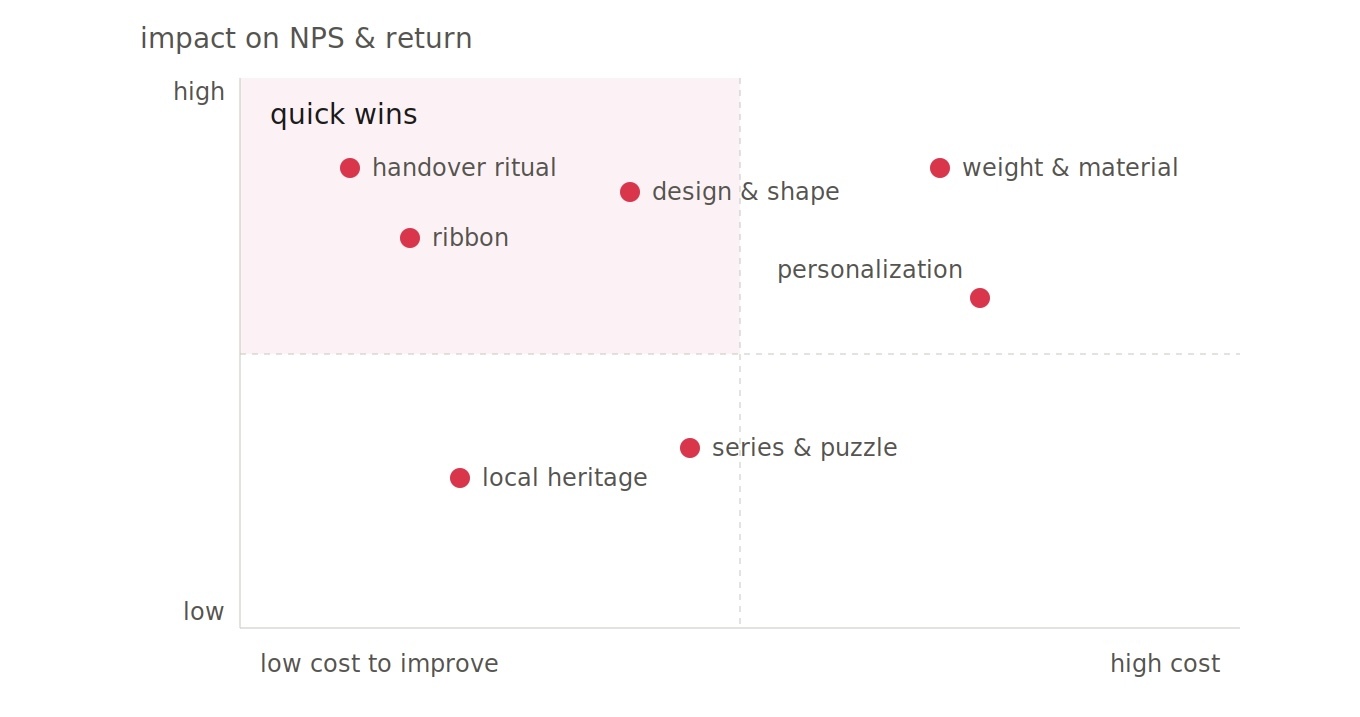
- Treat the medal as an investment, not a cost line. Saving on metal and ribbon costs you loyal customers. Put the money into casting, dimensional design, and quality enamel.
- Build the medal into your pre-sales cycle. Finalize the design by the time registration opens and show renders or sample photos. That is a lead magnet.
- Get the most out of the ribbon. The ribbon is the first thing in a close-up shot. Full-color sublimation on satin, with your logo, the year, and a hashtag, carries your brand across hundreds of thousands of posts.
- Set retention on series. Composite medals for a race series, and awards for a number of finishes, raise the lifetime value of each runner.
- Ritualize the handover. Train volunteers to place the medal around the neck with a word of congratulation and eye contact, not to hand it over from a box. That moment ties the emotional peak to your brand.
- Protect the finisher status. Do not dilute the award by giving it to everyone; for results-driven races, exclusivity is the core of its value.
- Measure the medal on its own. Add a question to your post-event survey, "how much did you like the medal," with an open comment, and track the correlation with overall NPS and intent to return.
- Offer eco options. The choice to skip a medal in favor of planting a tree, or a collection point for recycling, adds a human context to your brand.
This is where our own practice comes in. At WITISI we treat the medal as an emotional tool, not a line on an invoice, and the same goes for the rest of the finish-line kit we produce: medals, apparel, and on-site laser engraving.
The bottom line
A medal is a promise made physical. Keep it without compromise on quality, and with a real grasp of your audience's psychology, and you do not get a cost line. You get a base of promoters who return to the start year after year and bring new runners with them. In an industry where people look for recognition and meaning, not just a race, the medal stays one of the sharpest tools in event marketing.